

Akvelon engineers introduced a structured AI-assisted workflow for large legacy systems where development often depends on fragmented documentation, distributed knowledge, and manual context reconstruction. The workflow reduced repetitive engineering overhead, improved AI usage across delivery stages, and reduced repeated large-context prompting through reusable context artifacts.
About the project
Akvelon engineers worked with a large legacy software product with established delivery processes and strict reliability requirements.
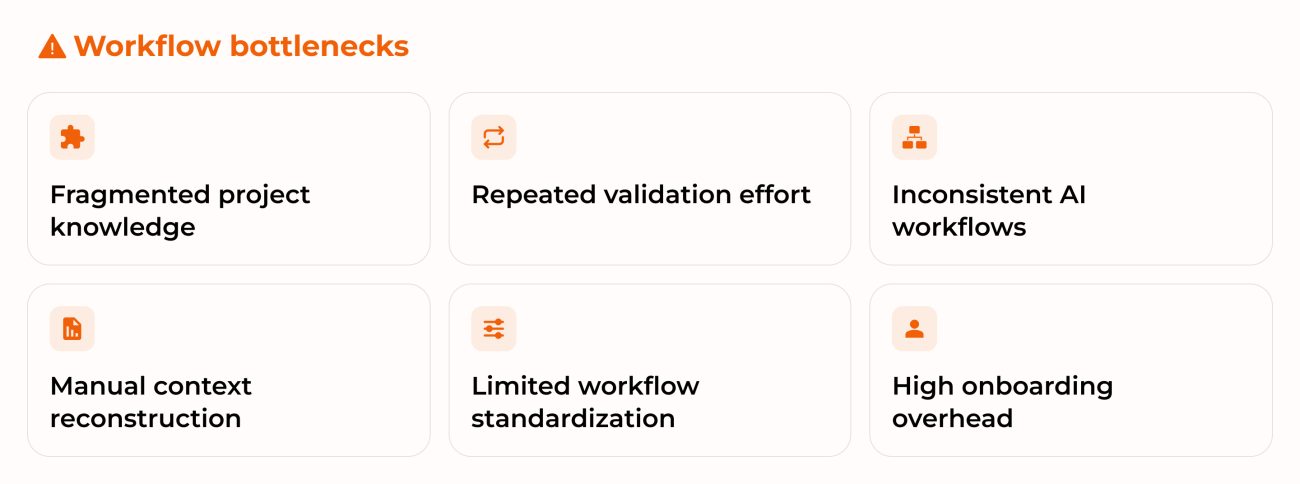
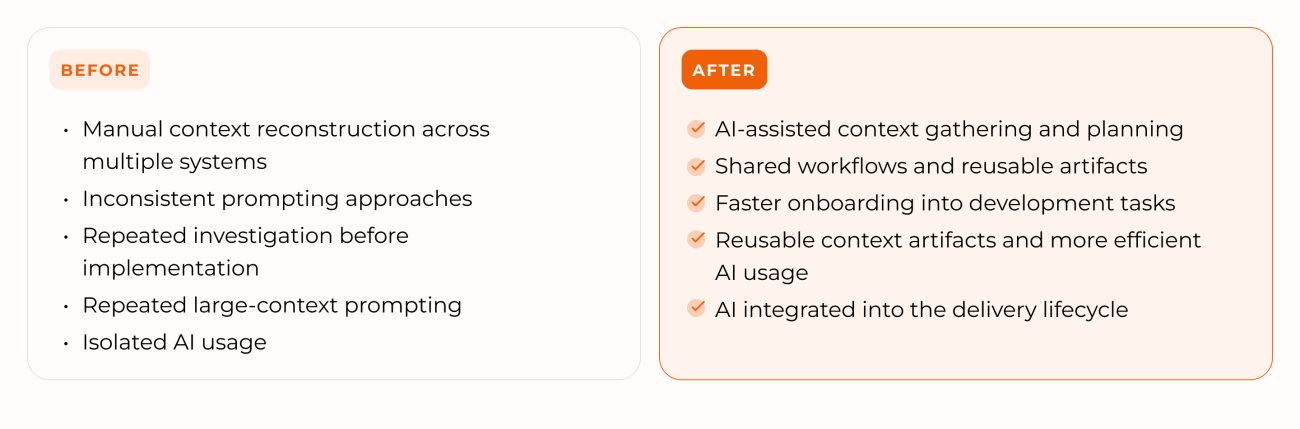
Before implementation could begin, developers often spent significant time reviewing documentation, understanding existing behavior, identifying affected modules, and reconstructing implementation context across multiple systems. The work was repetitive and heavily dependent on manual knowledge gathering.
To reduce repetitive investigation and context reconstruction, our team introduced an AI-assisted workflow integrated into the existing SDLC. AI became part of planning, implementation, validation, and review workflows rather than isolated coding tasks.
The challenge: From isolated AI usage to repeatable workflows
AI usage across the development process remained inconsistent. Engineers used different prompting approaches, context formats, and validation methods, while AI was mostly used for isolated tasks rather than shared workflows.
As a result, teams lacked a shared approach to using AI across the delivery process, leading to repeated large-context prompting and inefficient AI usage.
Technical approach: Embedding AI into the SDLC
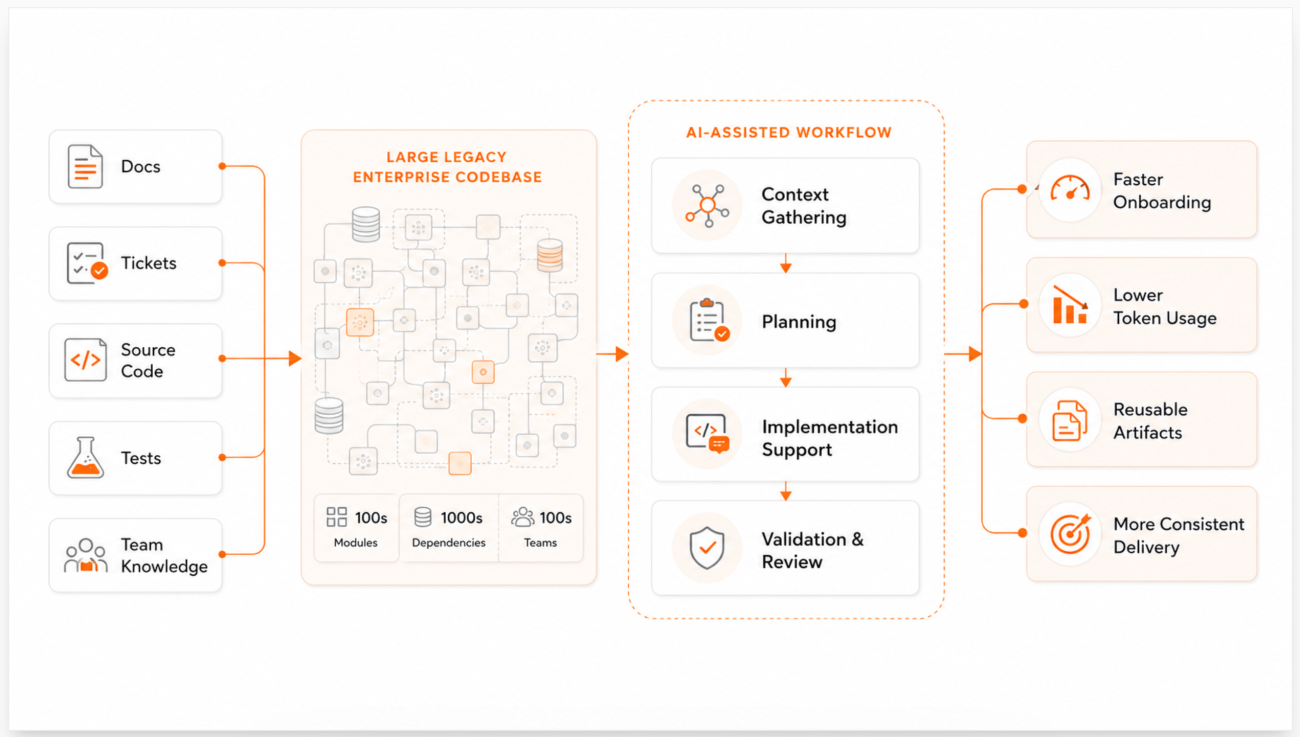
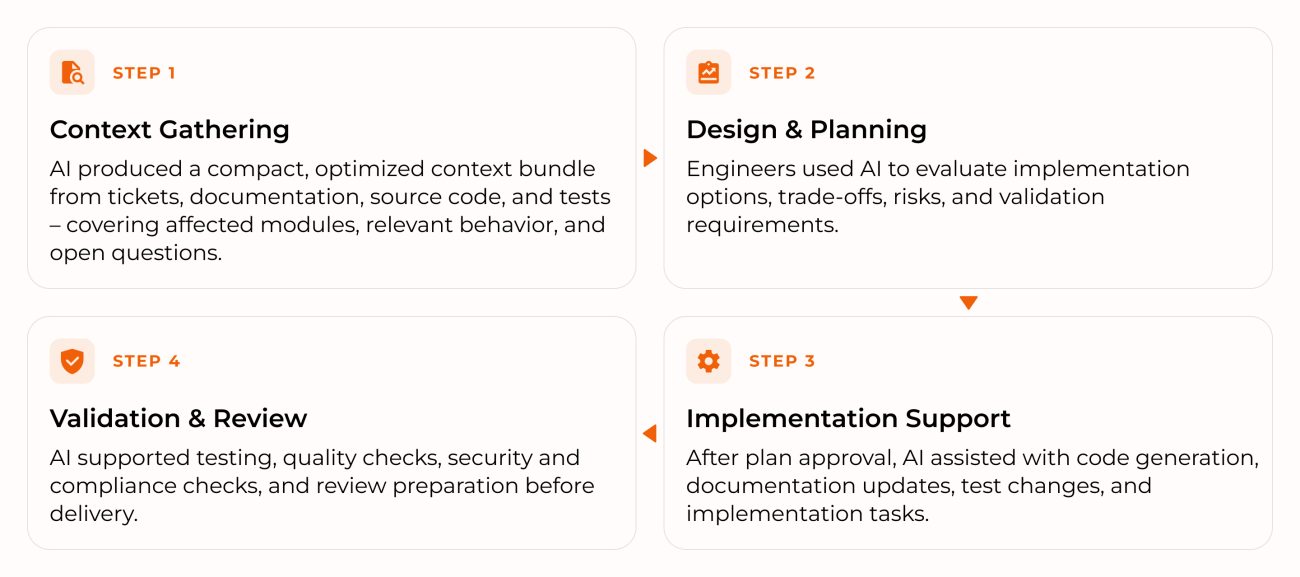
Instead of treating AI as a standalone coding assistant, Akvelon engineers integrated AI into planning, implementation, validation, and review workflows across the SDLC.
AI workflow architecture
The solution followed a human-controlled agentic model where AI supported context gathering, planning, implementation, and review, while engineers remained responsible for architectural decisions, implementation direction, and final quality control.
To manage context quality across a large codebase, engineers applied context optimization techniques when preparing inputs for AI: consolidating only relevant documentation, limiting scope to affected modules, and structuring inputs to avoid redundant or low-signal content.
AI behavior was guided through persistent instructions, reusable prompt templates, and project-specific skills, ensuring consistent output quality across team members and reducing the variance introduced by ad hoc prompting. This made AI outputs more predictable and easier to validate against engineering standards.
Workflow artifacts
AI-generated outputs were saved as reusable project artifacts rather than remaining in temporary chat threads.
For example:

This reduced repeated investigation work and made implementation easier to review, validate, and reuse across the team.
AI across the development workflow
The process followed the existing SDLC structure, with AI supporting key stages of delivery.
Operational impact & business value
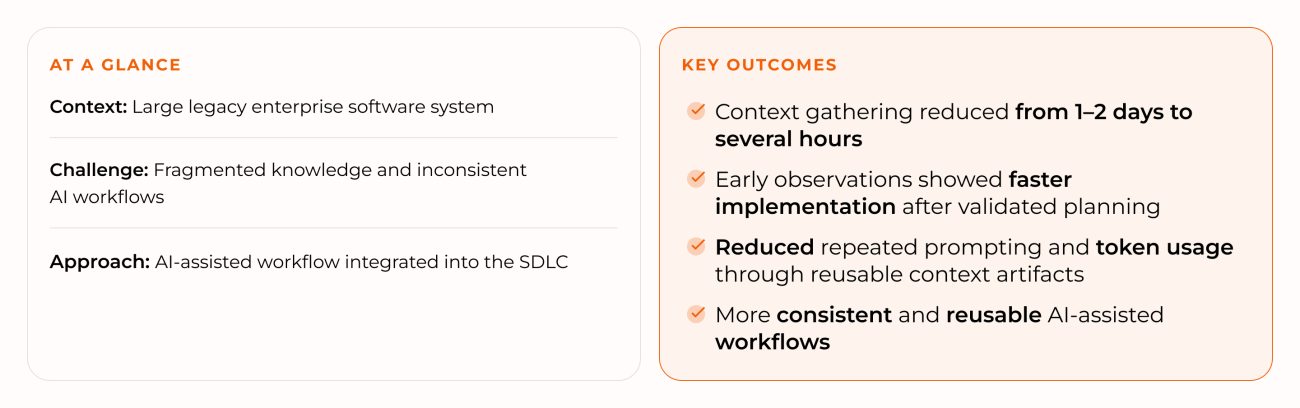
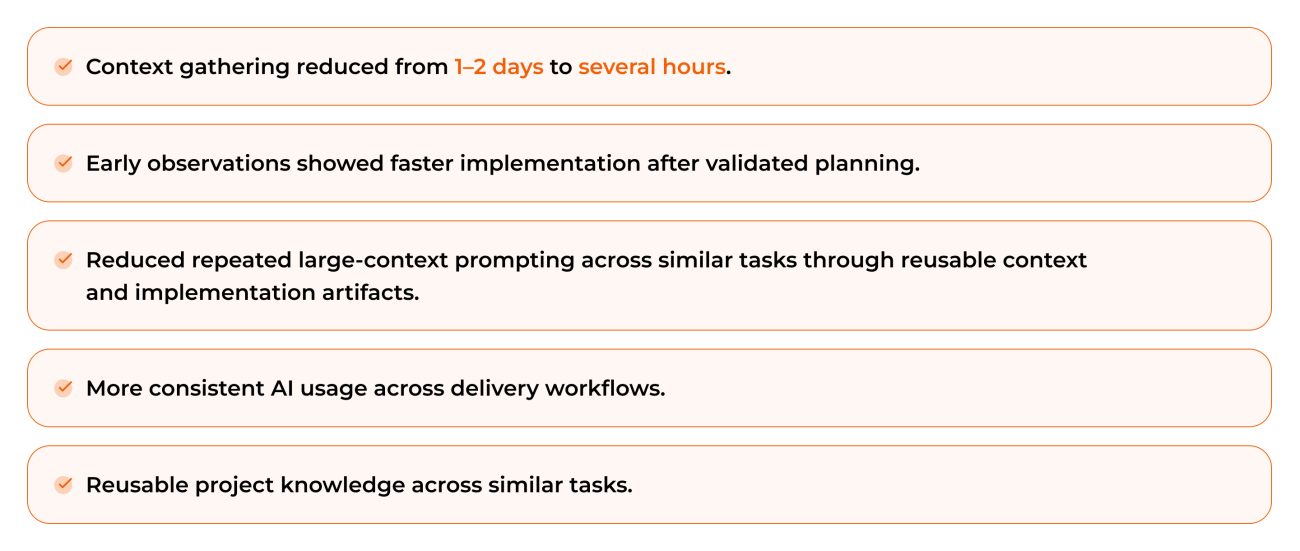
The biggest improvements appeared at the start of the development process, where engineers previously spent much time reconstructing implementation context before coding could begin. AI reduced repetitive manual work and helped teams move faster through development and review workflows.
Reusable context and implementation artifacts also reduced repeated large-context prompting, improving AI efficiency and reducing token usage across similar tasks.
Key outcomes
Where this workflow is most valuable
This approach works best in large engineering environments where teams spend significant time navigating complex systems, distributed documentation, and long-established delivery processes. It is especially valuable when AI adoption needs to fit into existing engineering practices rather than operate as a separate experimental workflow.

Conclusion & what’s next
This project showed that AI works best when it becomes part of the engineering process rather than a standalone coding tool. By introducing reusable context, shared workflows, and AI support across planning and review, Akvelon engineers reduced repetitive work and made development workflows easier to scale across the team.
The next step is expanding AI support into testing, review, and delivery workflows while keeping engineers in control of critical decisions and final quality. The long-term goal is a more practical and scalable approach to AI-assisted software delivery.