

AI coding tools can increase engineering output and quietly multiply cost, correction loops, and workflow inconsistency.
Here's how to spot the problem, and the five disciplines that keep it from happening:
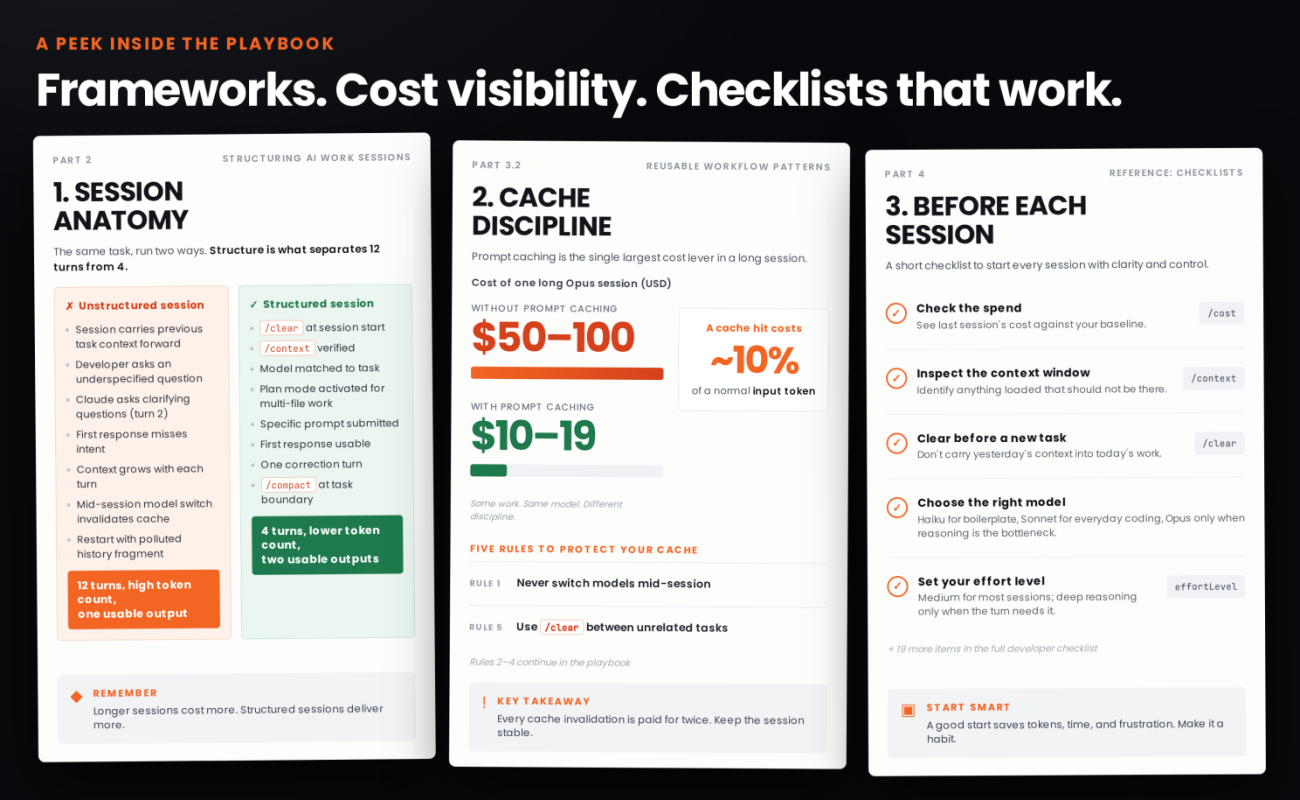
AI-Assisted Engineering Workflow Playbook – practical workflow disciplines for controlling AI engineering cost, context, and repeatability.
A cached token and an output token are not the same expense. On Claude Code with Sonnet 4.6, a cache-hit token costs $0.30 per million tokens. An output token costs $15.00 per million tokens. That's a 50× difference, and it's not a rounding artifact or a worst-case scenario. It's the baseline economics of every AI coding session your team runs.
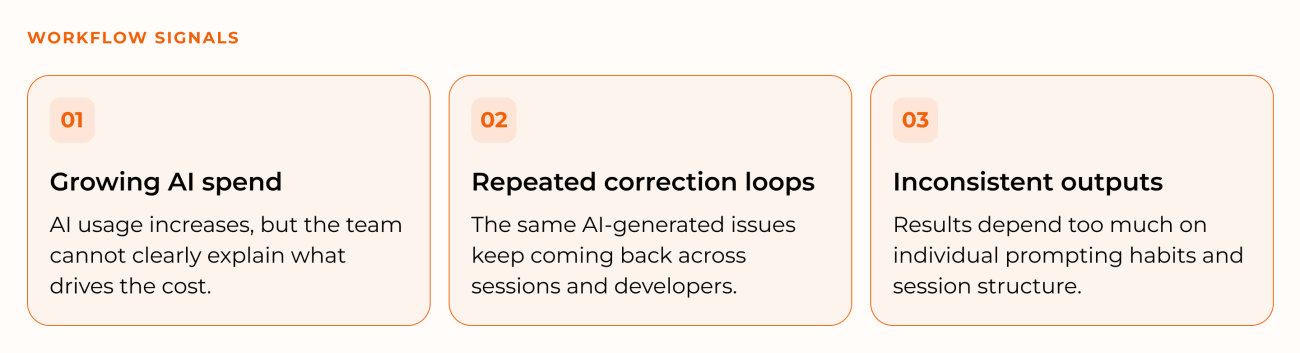
AI coding tools aren't expensive by default, yet unmanaged workflows are. The gap between a typical $13-a-day session and a $30-a-day outlier (same tool, same codebase) comes down far more to session habits and cache discipline than to which model was picked.
AI adoption is not the same as workflow maturity
AI coding tools are quickly becoming part of everyday engineering work. But access is not the same as operational maturity.
As AI usage expands across a team, the challenge is building workflows that engineers can use consistently, measure, and manage.
Two developers can use the same AI assistant in very different ways – one keeping sessions open across unrelated tasks and rebuilding instructions from scratch each time, the other working with shared project conventions, clear task boundaries, and automated checks. From the outside, both are "using AI." Operationally, they are running different engineering workflows.
That difference creates hidden overhead that shows up long before anyone traces it back to a workflow problem.
Why the economics matter
Call it the structure gap: the distance between the two developers above comes down to whether their sessions are structured, not to skill or effort, and it's where the 50× ratio does its damage. A structured session (clear scope, a fresh cache, the right model for the task) spends most of its tokens on cheap cache reads and a tight amount of output. An unstructured one carries stale context forward, breaks the cache with a mid-session model switch or a dynamic system prompt, and pays close to full output-token price on nearly everything it does.
Same tool, same task, a materially different bill, and the resulting overhead traces back to workflow decisions, not the model itself: session structure, context management, matching model to task, and cache discipline, compounding turn after turn.
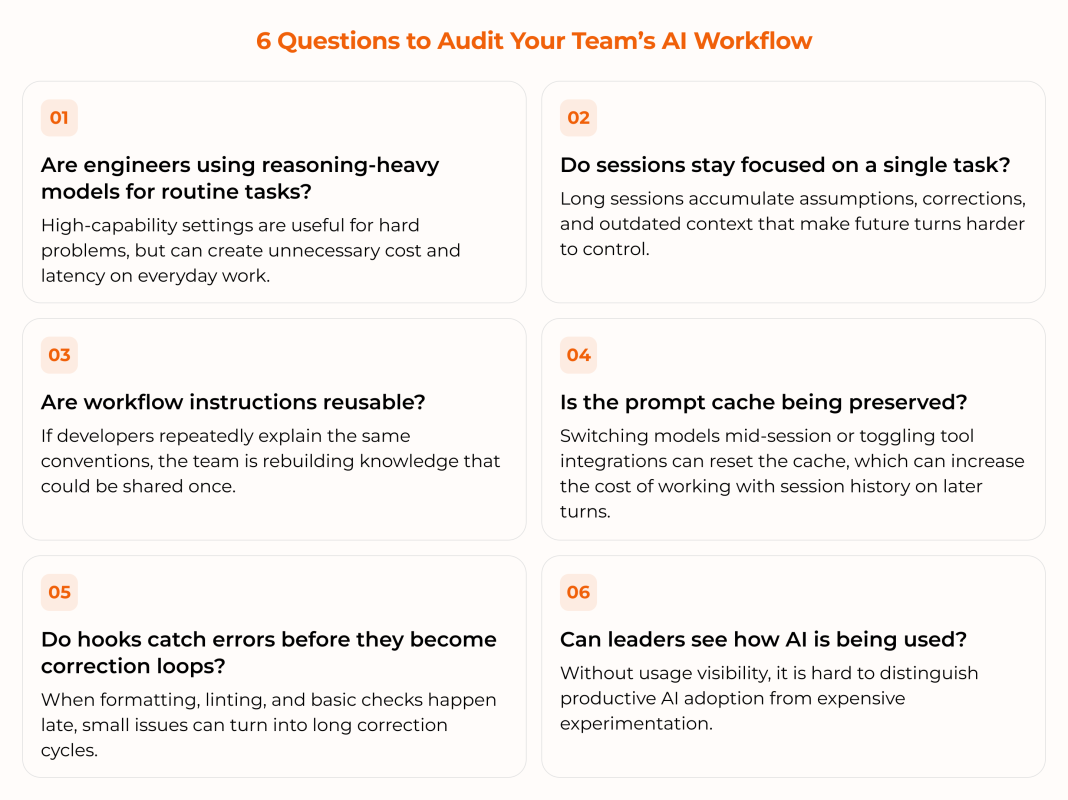
Six questions that Surface AI workflow gaps
Before you can fix a workflow gap, you need to know it's there. The six questions below help surface the most common ones. Use them as a quick check before scaling AI-accelerated development across teams.
What disciplined AI-assisted engineering looks like
Asking the right questions surfaces the gap. Closing it comes down to five workflow disciplines Akvelon applies directly in production Claude Code usage:
- Match model capability to the task. The strongest model available isn't the right default for every task. Reserve deep reasoning for architectural decisions and multi-file refactors; use lighter models for renames, boilerplate, and routine bug fixes.
- Keep project context lean. Every token loaded at session start is a token paid for on every single turn. Auditing what's actually in context, and trimming what isn't earning its place, is one of the highest-leverage habits available.
- Turn repeated instructions into reusable skills. Loading everything into one static configuration file scales poorly. Structuring recurring workflows as on-demand skills means the team only pays for context it's actually using in that session, not everything it might ever need.
- Preserve prompt caching. A cache hit costs a small fraction of a normal input token. Model switches mid-session, toggled tool configurations, and content that changes between requests all break the cache, and the team pays full price for the entire prior context when that happens.
- Measure usage and cost. None of the above is verifiable without visibility into what a session actually costs and what's consuming the context window. Checking this at the start of a session, and reviewing trends weekly, is what turns discipline into a habit instead of a one-time fix.
None of this requires new infrastructure. It's configuration and habit, which is why it's also easy to skip.
AI-Assisted Engineering Workflow Playbook
Akvelon's AI-Assisted Engineering Workflow Playbook goes deeper into the mechanics:
- the exact commands
- configuration files
- checklists
- team-level governance controls behind each of the five disciplines above
Akvelon helps engineering organizations move beyond AI tool adoption and build managed, disciplined AI engineering workflows – with cost visibility, reusable standards, automation, and team-level governance. Reach out.