

Dear friends, colleagues, and partners,
AI creates business value when it changes how work gets done – not simply when people use AI tools. The strongest evidence is what happens to the workflow: how work moves from intent to production, how humans validate AI output, and what changes you can measure.
In this edition, we share three Akvelon client projects showing measurable engineering results from AI, followed by the operating principles, AI-assisted workflows, and technology capabilities that help make those results possible.
AI adoption is easy to quantify. AI value is harder to prove.
Mark Boyes, CRO at Akvelon, says in his latest post that leaders should look beyond AI usage and ask what has actually changed: cycle time, rework, release safety, and return on AI spend.
Three Akvelon projects below show what this focus on measurable impact looks like in practice — with AI removing engineering bottlenecks, reducing manual effort, and improving how work moves through delivery.

Case study: Scaling Legacy .NET Modernization with an AI-Assisted Migration Toolkit
AI accelerated the migration itself, but it exposed the next bottleneck: manual validation. Engineers still had to download and compare build outputs, prepare evidence, and manually resolve review issues.
In this case study, we share how Akvelon extended the workflow to remove this bottleneck by combining build-output validation and migration review in a single migration toolkit.
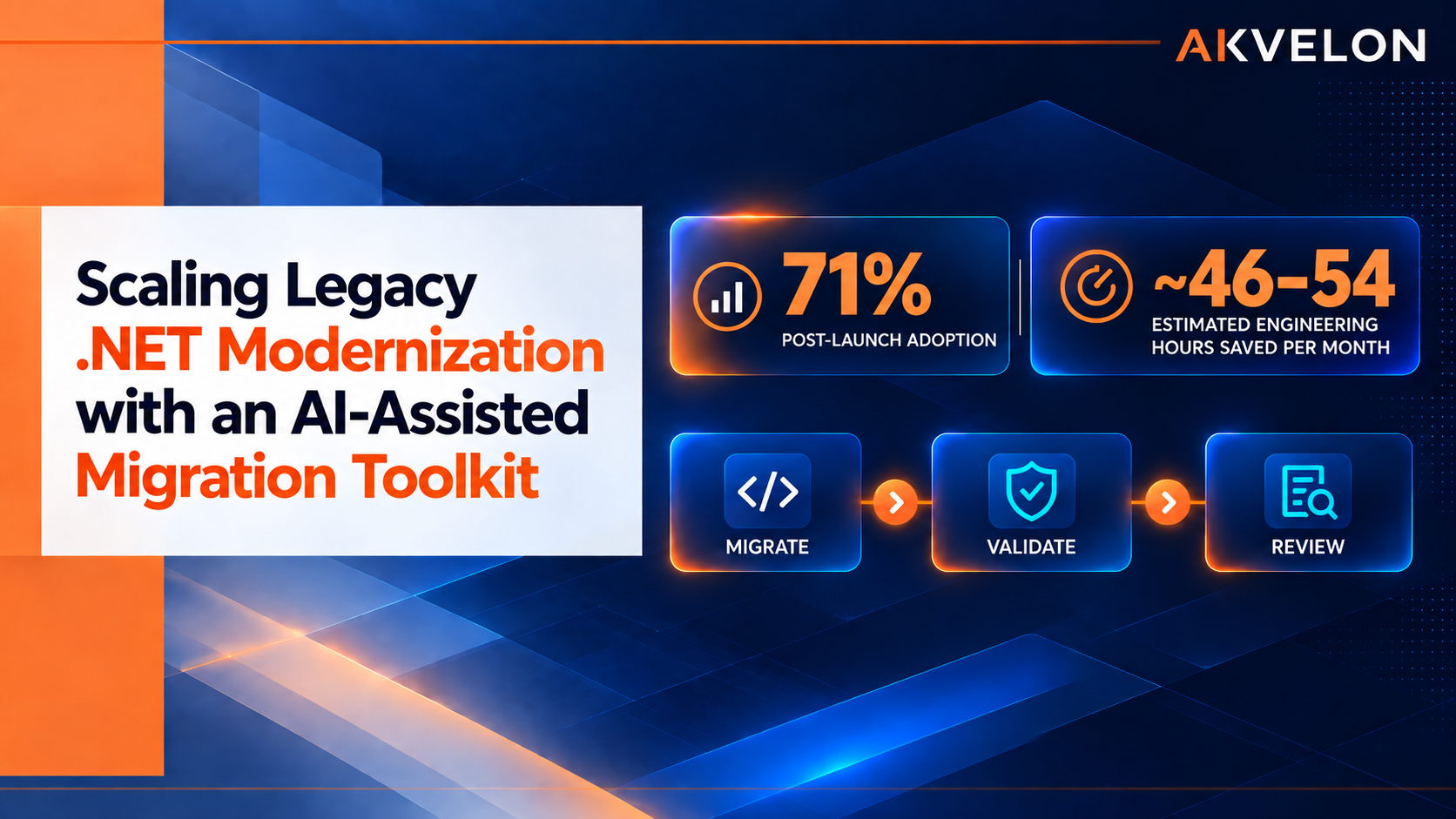
Results since rollout:
- 71% adoption among relevant migration PRs.
- ~46–54 hours saved per month.
Scale: ~696 projects remain eligible for the workflow.
Case Study: Build Artifact Validation: 30 Minutes → 1 Minute
Build artifact validation previously required manual downloads, multiple tools, and roughly 30 minutes of engineering time per run.
This case study shows how Akvelon automated the process, including artifact downloads, JSON configuration comparison, discrepancy detection, and standardized reporting.
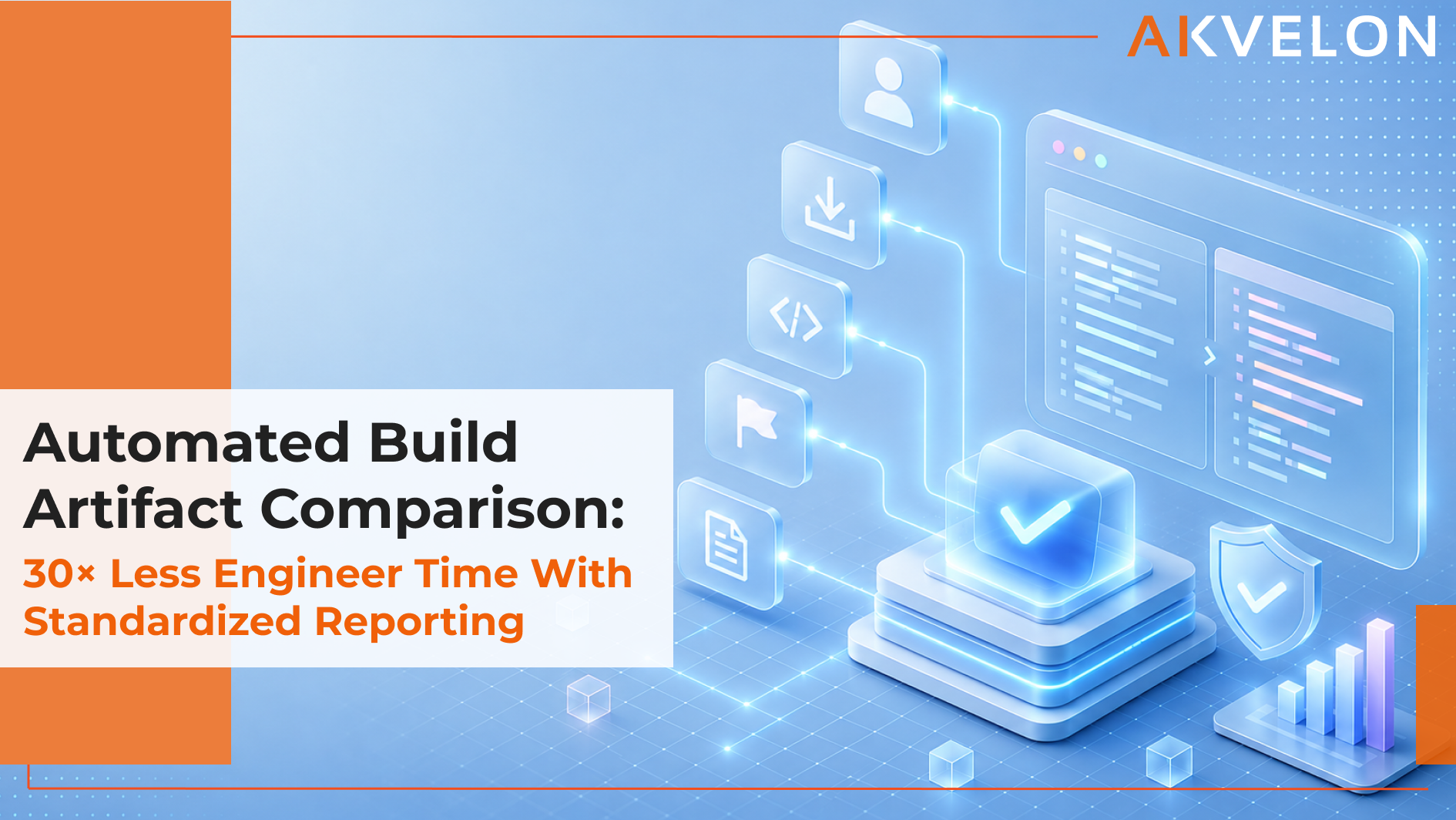
Result: hands-on time dropped to ~1 minute per run, with engineers focusing on flagged differences rather than locating them across tools.
Case study: AI Skill for GitHub Copilot: Feature Flag Cleanup
Feature flag cleanup is a recurring engineering task.
In this case study, we share how Akvelon built an AI skill for GitHub Copilot that handles preparation work inside the existing workflow – from identifying flag types and updating production code to removing test references and preparing PRs for review.
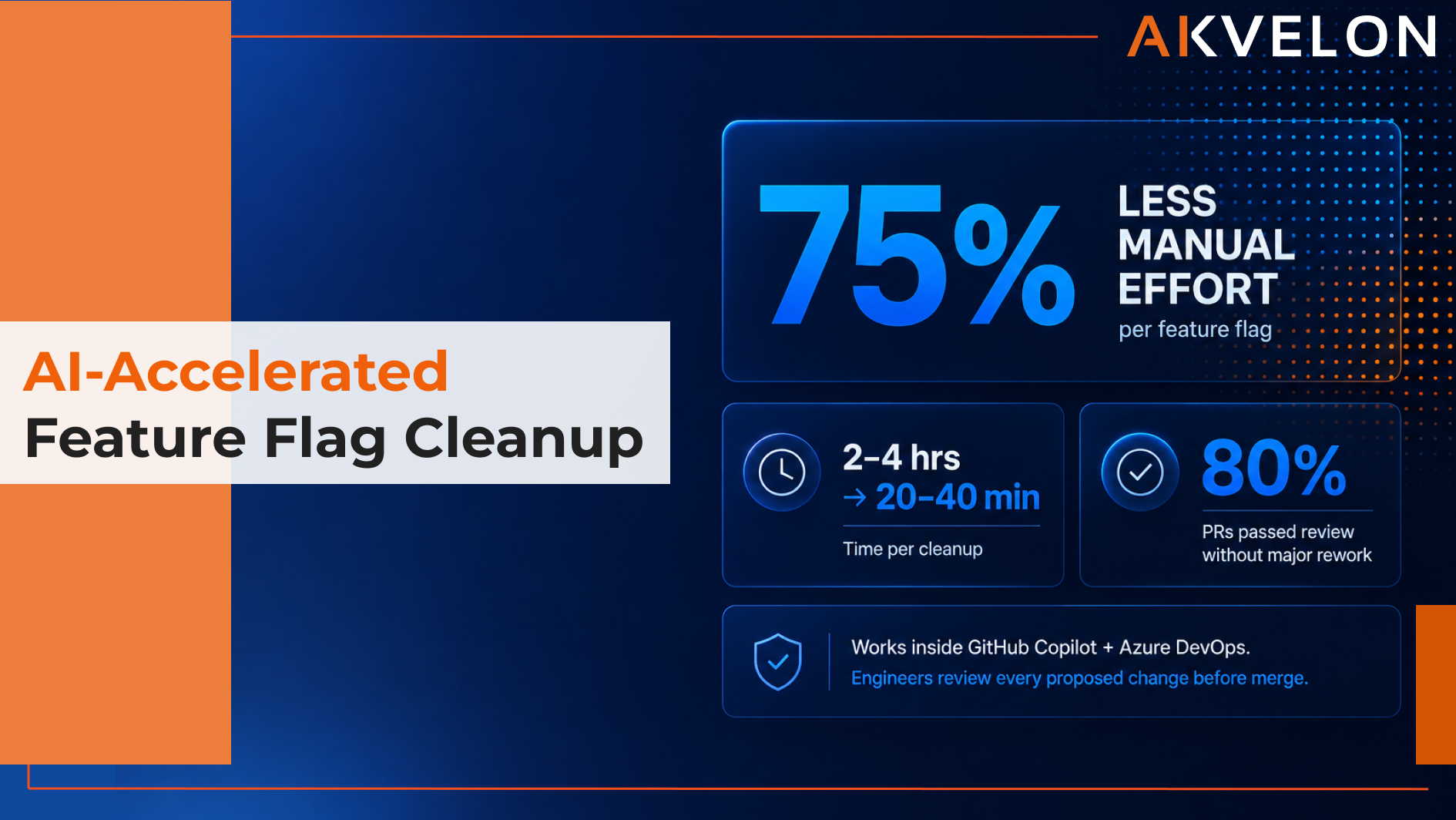
Results from one three-week sprint:
- 2–4 hours → 20–40 minutes per cleanup
- ~75% less manual effort per flag
- ~80% of PRs passed review without major rework
What It Takes to Scale AI-Native Delivery
Those client projects show different applications of AI, but they share a common pattern: the value comes from changing the workflow around the technology.
The sections below show how Akvelon approaches these changes in practice.
The Workflow Discipline Behind AI-Assisted Engineering
Two developers. Same model, same tools. Very different results.
The difference is often in the workflow around the model: how engineers structure context, manage sessions, select models, and reuse proven patterns.
Without a disciplined workflow, AI can simply amplify weaknesses that already exist in the engineering process.
Akvelon's AI-Assisted Engineering Workflow Playbook explains why the way engineers work with AI matters as much as the model itself.
As Agents Take On More, the Engineer's Role Shifts
As agents take on more implementation work, the engineer's role shifts from writing every line to defining intent, constraints, and acceptance criteria while validating what the agent produces.
Agents implement and iterate; validation runs throughout, not just at the end.
What matters is how reliably work moves from intent to production.
More on how this looks in practice → in our Linkedin post.
RAISE: A Framework for Governed AI in Financial Services
In regulated environments, redesigning the workflow is only part of the challenge.
Organizations also need stronger ways to decide which AI opportunities are worth pursuing, how to govern them, and how to measure their value.
Akvelon’s RAISE framework helps organizations evaluate AI opportunities across Reliability, Adoption, Integration, Security, and Efficiency, linking AI investment decisions to measurable outcomes and the conditions required for production use.
The goal is to identify where AI can create real value and establish the conditions needed for responsible production use.

New Partners: Expanding the AI Delivery Stack
Akvelon’s new technology partnerships span key layers of the AI delivery stack, from platforms and data to observability and compute.
AI Platforms
OpenAI, Claude, and IBM
Akvelon has joined the OpenAI Partner Network, become a Claude Services Partner, and achieved Silver tier in IBM Partner Plus with a focus on IBM watsonx and generative AI.
These partnerships expand the technologies and platforms Akvelon can leverage across software engineering, data, cloud, QA, and DevOps.
Data Foundations
Snowflake and Fivetran
Akvelon is now a Snowflake Partner and a Fivetran Influence Partner, expanding capabilities across data engineering, automated data movement, analytics, and the data foundations needed for AI.
Observability & Compute
Datadog and Intel
Akvelon has joined the Datadog Partner Network and the Intel® Partner Alliance as a Solution Integrator, adding observability, application performance, and high-performance compute to how Akvelon designs and delivers AI workloads.
Together, these partnerships give Akvelon broader coverage across the technologies that support AI delivery.
Join Us at Upcoming Events
Kirill Nesterenko, Akvelon's Director of New Business Development, will be attending:
- TechExpo Europe — October 20 · Amsterdam, Netherlands
- WebSummit 2026 — November 9 · Lisbon, Portugal
- Slush 2026 — November 18 · Helsinki, Finland
If you’ll be visiting any of these events or would like to connect, reach out to Kirill via LinkedIn.

Keep up with the latest news from the tech world, carefully curated and analyzed by Akvelon's experts.
- Microsoft 2026 Work Trend Index: The AI Adoption Gap People are adopting AI faster than organizations can redesign the processes, governance, and operating models around it. The gap is increasingly about organizational readiness, not individual access to AI tools.
- Google Cloud: AI-Native Security Embedded Into the Engineering Workflow Google’s engineering team is using AI agents to scan code changes at scale, embedding vulnerability detection directly into the software development lifecycle – a practical example of AI agents becoming part of production engineering workflows.
We’d love to hear which operational AI, infrastructure, or engineering topics you’d like us to explore in future editions. Email us at info@akvelon.com!