


From RFP Inputs to Spec-Driven Delivery Plans
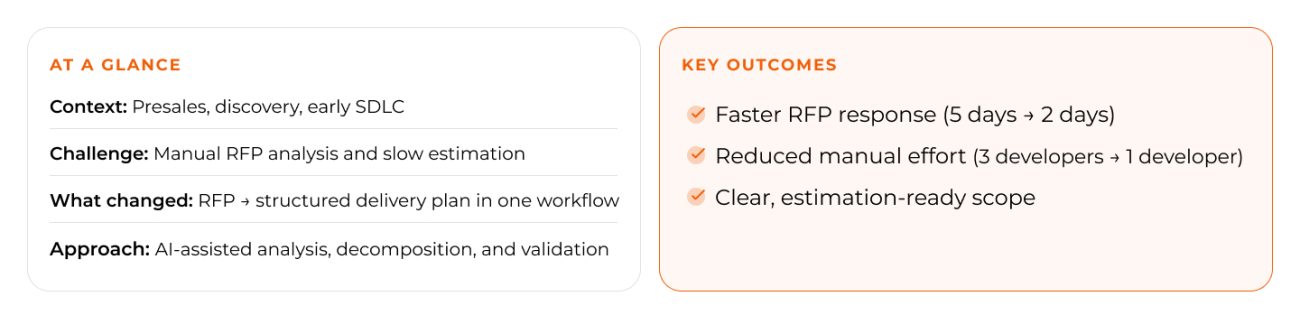
Akvelon developed an AI-assisted RFP analysis and estimation workflow for presales, discovery, and early SDLC teams. It turns scattered inputs – including one-pagers, meeting notes, unstructured RFPs, and structured requirement documents – into grouped workflows, actionable tasks, and estimation-ready delivery plans.
The workflow also serves as a foundation for spec-driven development by creating a structured specification layer. Requirements are grouped into workflows, checked against existing product capabilities, decomposed into delivery tasks, and prepared for estimation and implementation planning.
What the workflow does
When a new RFP arrives, the first step is always the hardest: to understand what needs to be built and how to estimate it.
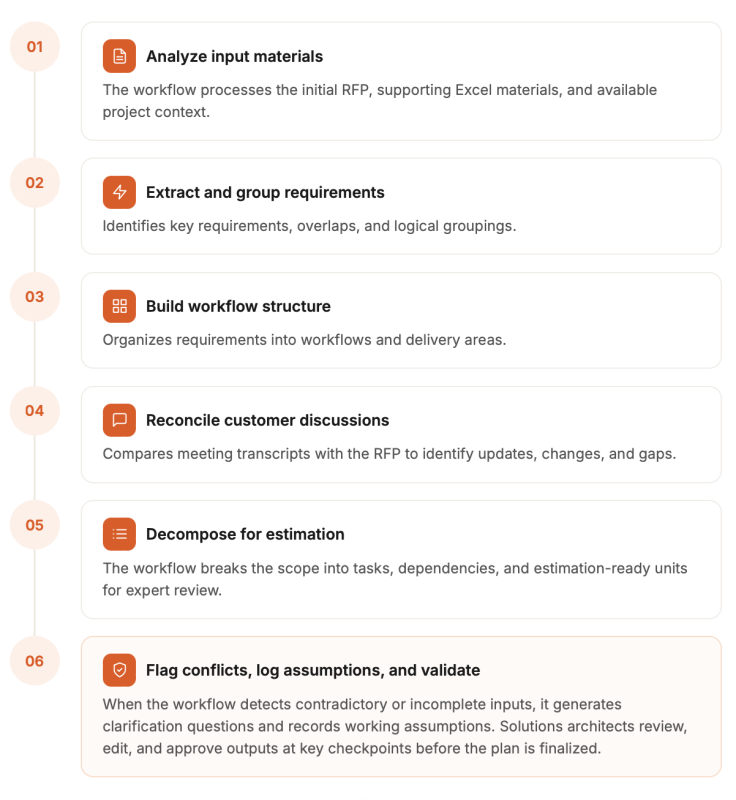
We developed an AI-assisted workflow to support this stage. It processes RFP inputs, extracts and reconciles requirements, groups them into workflows, and decomposes them into actionable tasks.
This approach follows a spec-driven model: instead of estimating from fragmented documents and meeting notes, the team first turns inputs into a structured specification. This specification becomes the basis for workflows, task decomposition, dependencies, risk assessment, and implementation planning.
In this context, spec-driven development means turning early business inputs into a structured specification before estimation and delivery planning begin.
We apply this workflow to real RFPs to generate structured outputs that teams can immediately use in presales and discovery, and carry forward into delivery planning as requirements evolve.
The challenge: fragmented RFP inputs and slow estimation
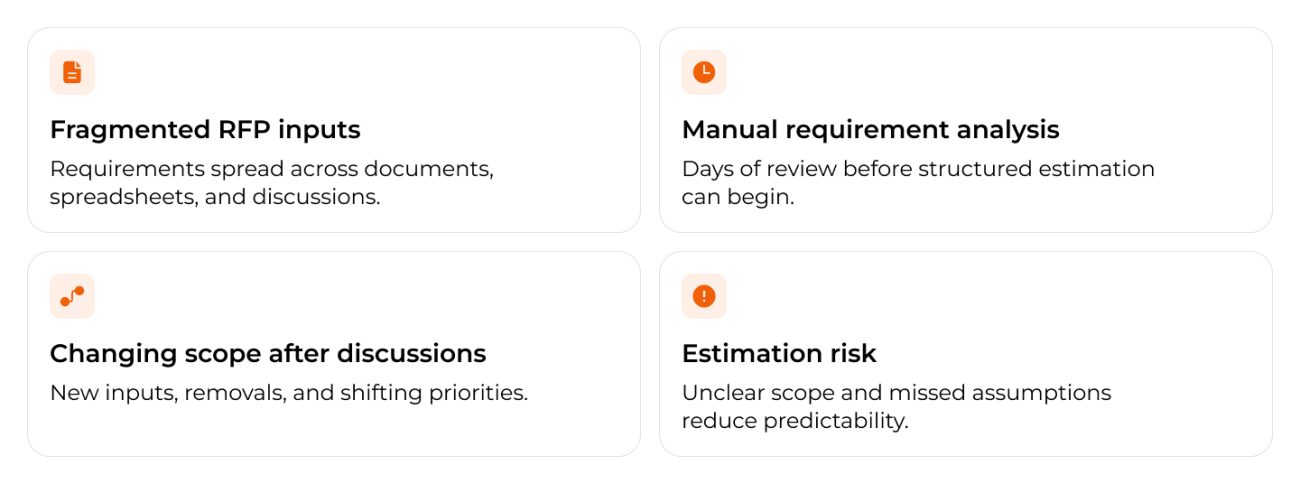
Large RFPs are often fragmented and inconsistent. Information is spread across sections and not always clearly defined.
Before any work can start, teams need to review the full document, align on scope, and prepare an estimate. This is mostly manual effort and can take days or even weeks.
Things get more complex after client discussions. New requirements appear, others change or disappear. Teams need to revisit and adjust everything again.
As a result, early stages slow down, estimation becomes less predictable, and important details are easier to miss.
Technical approach: How the AI-assisted workflow works
Akvelon applied an AI-assisted workflow using Copilot, structured prompting, project context, and expert validation.
The workflow processes both structured documents (e.g. Excel) and unstructured inputs such as meeting transcripts, turning them into estimation-ready plans with clear scope and task structure. The output remains aligned as requirements change.
Overcoming the Reality of Messy RFPs: Safeguards & The Human-in-the-Loop
In a perfect world, RFP inputs are crystal clear. In reality, they are often riddled with missing data, conflicting requirements, and technical ambiguities. The workflow doesn't expect perfection — it is designed to actively catch and isolate these issues through two core mechanisms.
Automated Clarification & Assumption Logging. When the AI encounters contradictory inputs — for example, a one-pager requesting offline-first mobile architecture while meeting notes imply cloud-only data access — it doesn't guess. Instead, it flags the conflict and compiles a structured list of clarification questions and working assumptions. This gives the presales team a ready-made checklist for client follow-ups, turning ambiguity into a collaborative alignment tool rather than a hidden delivery risk.
Human-in-the-Loop Checkpoints. AI accelerates the process, but human expertise remains the anchor. To prevent logical gaps or hallucinations from propagating, the workflow includes mandatory review checkpoints at every critical phase — from initial specification generation through to final task decomposition. Solutions architects can review, edit, and override outputs at any milestone, ensuring the final delivery plan reflects both technical reality and delivery standards.
Example outcome: From 30 feature requests to a structured delivery scope
In one case, the input materials included ~30 feature requests, a 4-page Excel document, and 7 hours of client discussions.
The workflow merged the original RFP, Excel-based requirements, and customer discussion transcripts into one structured view of scope, changes, open questions, and delivery priorities.
Using this workflow, the team structured the input into unified workflows and actionable tasks within 2 days. They got a clear view of scope, dependencies, and estimation inputs. The output also served as a structured baseline for delivery planning.
Business value
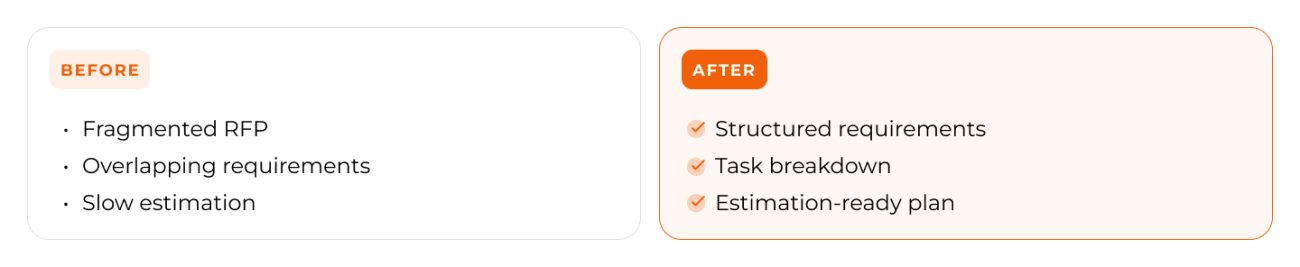
The workflow improves speed, clarity, and predictability in early project stages.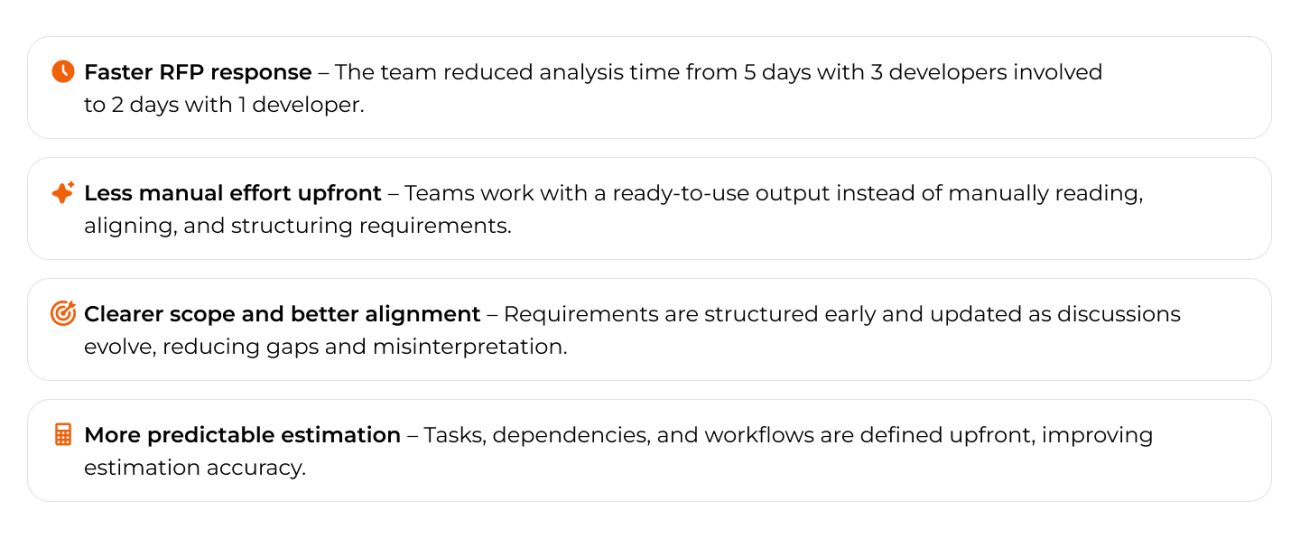
Where this workflow is most useful
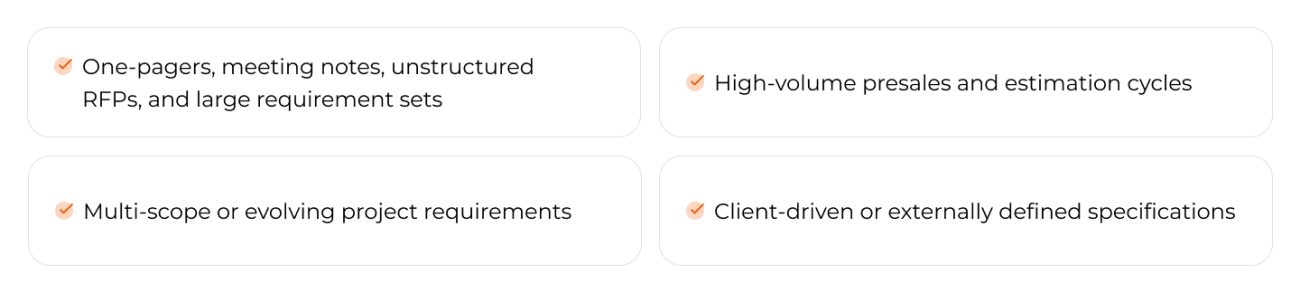
If your team spends days analyzing one-pagers, meeting notes, unstructured RFPs, or evolving requirements, Akvelon can help turn this process into an AI-assisted, spec-driven workflow.