

Akvelon built a Copilot-based AI skill that generates TypeSpecs from Resource Provider code, runs automated validation, and corrects detected issues before final engineer review.
About the project
Azure Resource Providers use TypeSpecs, structured API specifications that define how resources behave within the Azure platform. Preparing these specifications requires close adherence to Azure Resource Manager (ARM) guidelines. Errors or inconsistencies can delay the pull request and slow the broader migration workflow.
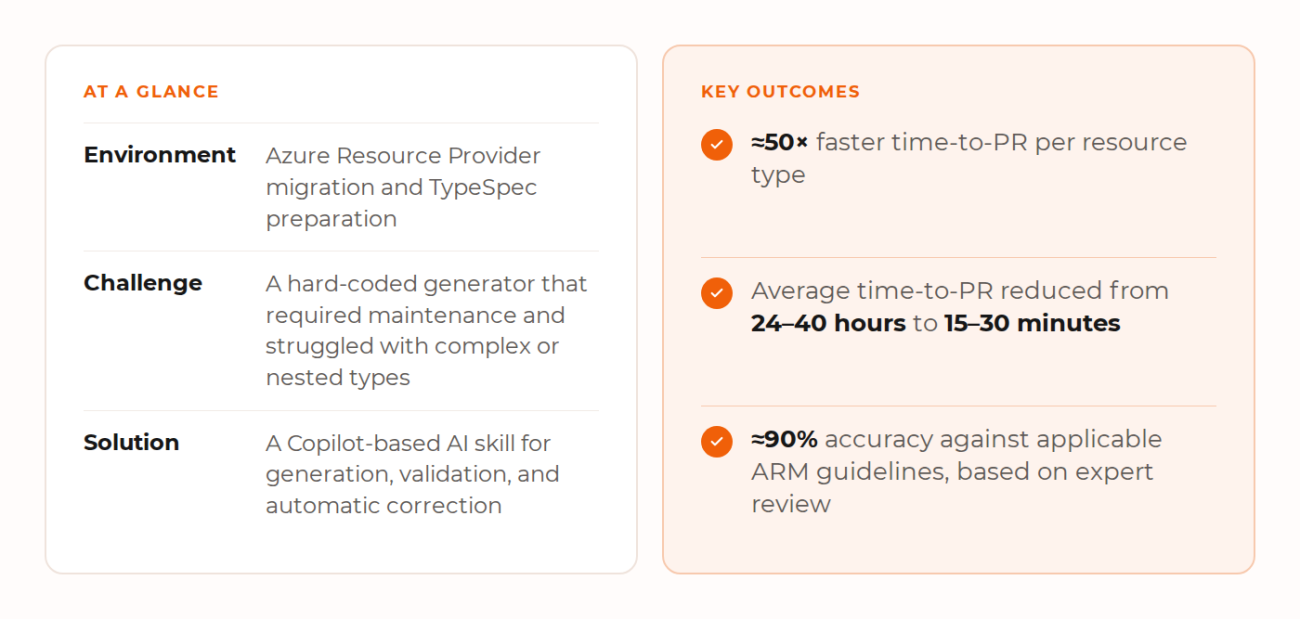
For a large enterprise client working on Azure Resource Provider migrations, TypeSpec preparation was already partially automated through an internal generator. However, its use was limited, and the tool relied on fixed, hard-coded logic that could not keep pace efficiently with changing requirements or complex resource definitions. The TypeSpec preparation cycle typically took 24–40 hours from initiation to PR readiness.
Akvelon introduced a Copilot-based AI skill to handle TypeSpec generation, validation, and error correction, reducing preparation time to 15–30 minutes per resource type.
The challenge: automation that could not keep pace with changing specifications
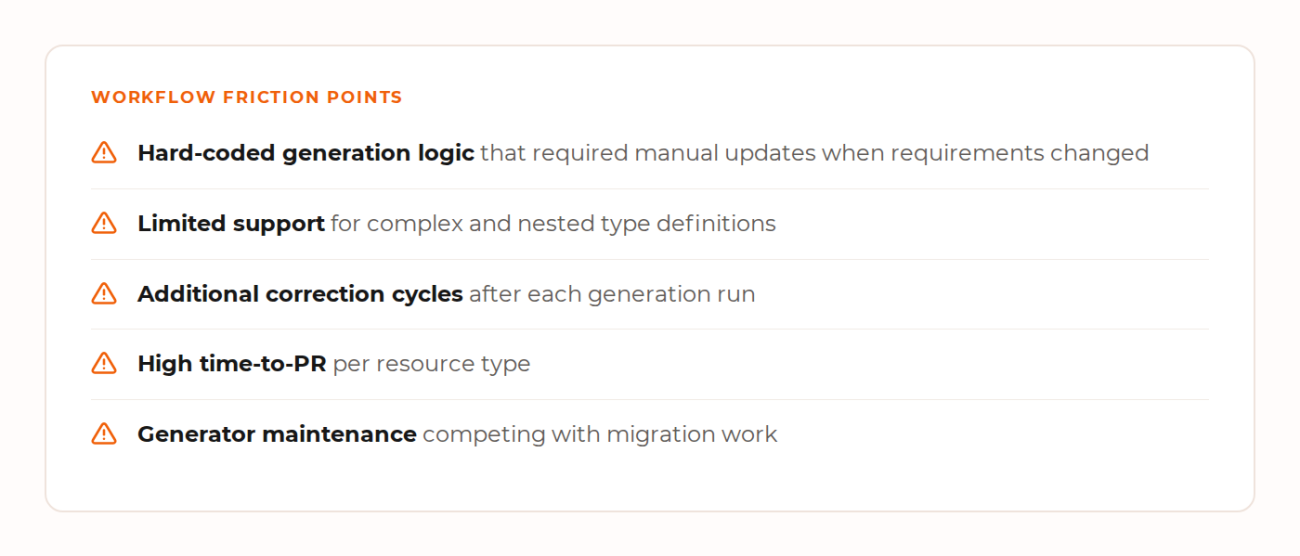
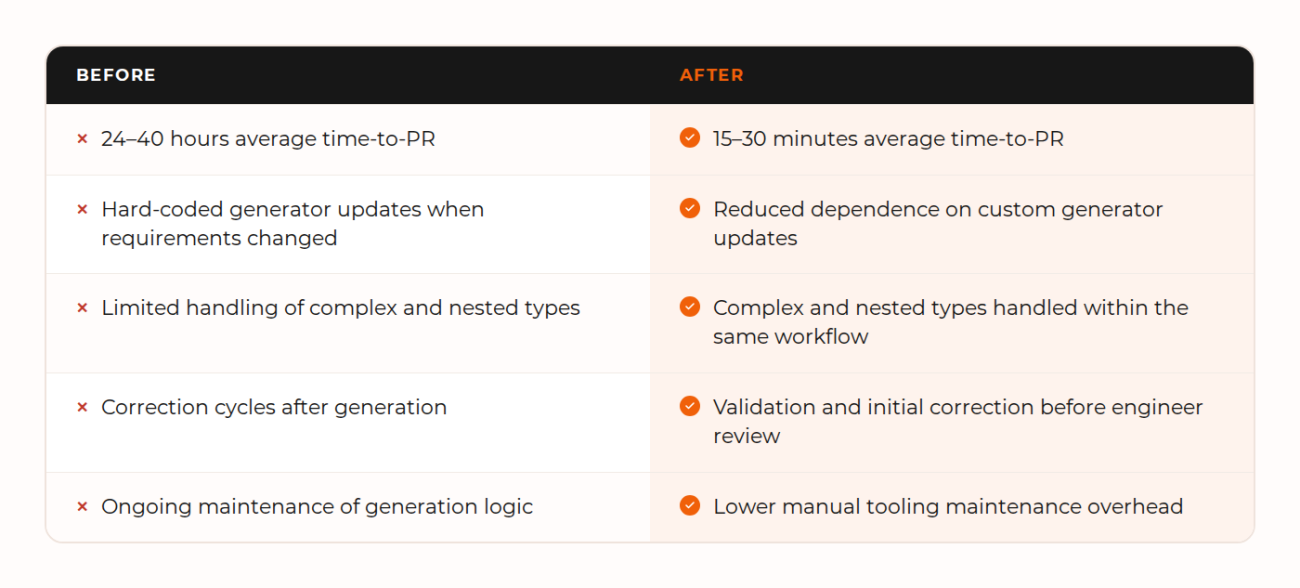
The internal tool used for TypeSpec generation was built around fixed logic. It worked when requirements were stable. Whenever TypeSpec requirements changed, engineers had to update the generator itself before they could continue with the specification work. The tool also struggled with complex and nested type definitions, which led to additional correction cycles after generation.
Across a migration program involving multiple resource types, the limitations accumulated: engineering time was split between maintaining the generator, correcting its output, and advancing the migration itself.
The solution: a new Copilot-based TypeSpec generation skill
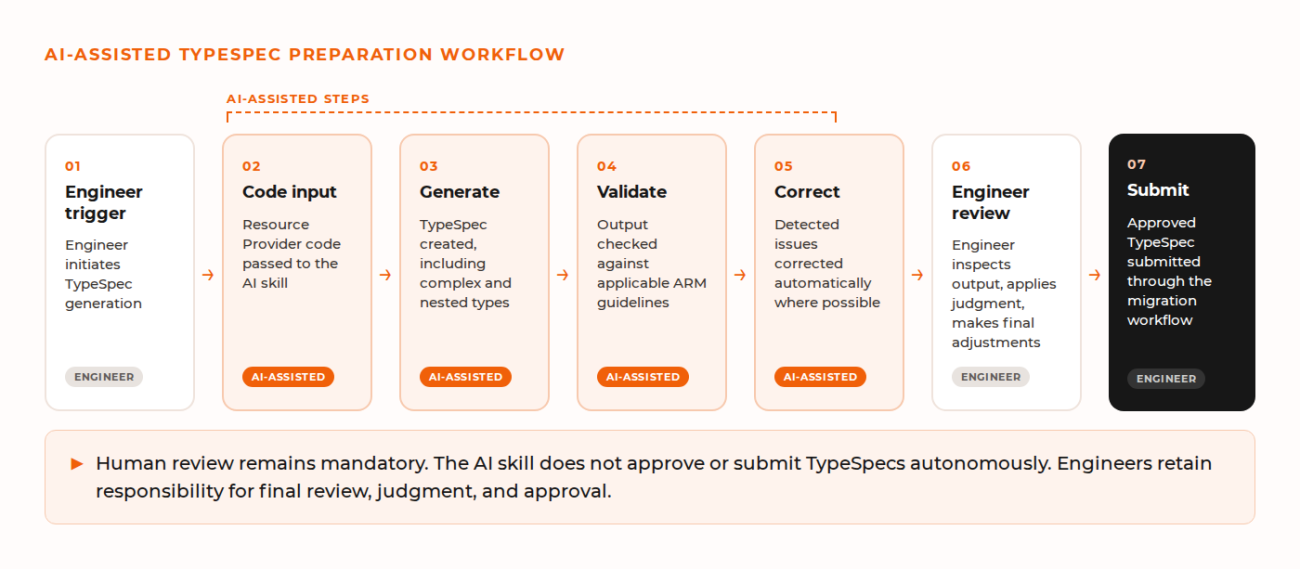
Akvelon built a Copilot-based AI skill that automates TypeSpec generation, validation, and initial correction. The skill takes Resource Provider code as input, generates a TypeSpec, validates the output against the applicable ARM guidelines, and corrects detected validation issues before the specification reaches an engineer.
The new skill replaced the rigid generator in this workflow. Its value was not simply that it produced the same output with a different technology. It shifted the operating model from hard-coded, maintenance-heavy automation to an AI-assisted workflow that can handle a wider range of TypeSpec structures in the same process.
What the AI handles, and what the engineer retains
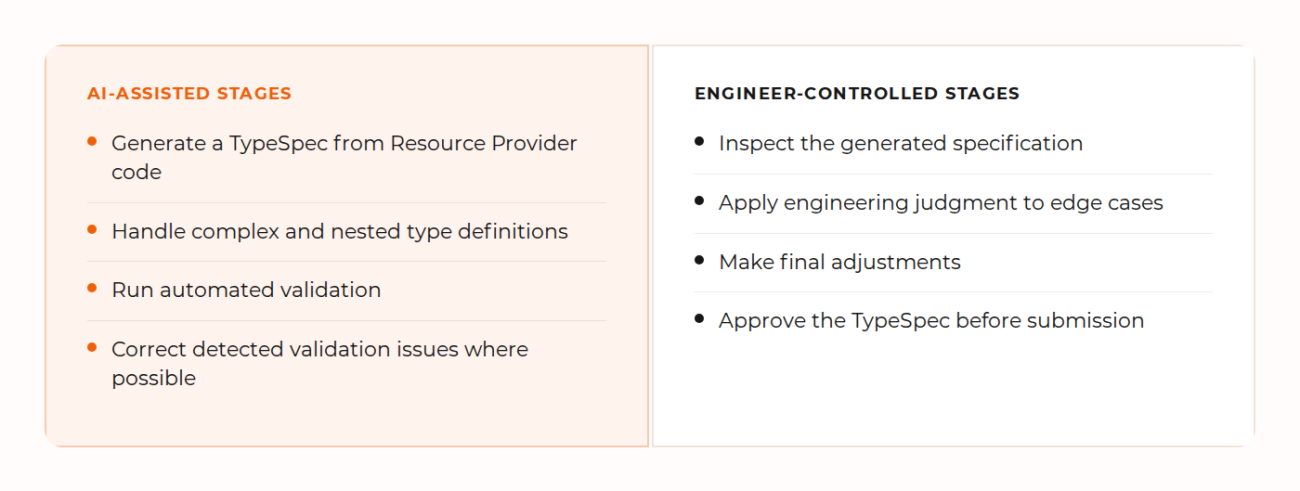
The skill generates TypeSpecs from code, including complex and nested type definitions that the previous tool handled poorly. It then runs ARM guideline validation and applies automatic fixes when it detects errors.
This means the output reaching the engineer is already validated and corrected, so engineers review output after automated validation and correction rather than starting from an unvalidated draft.
Human review is required before any TypeSpec is submitted. Engineers inspect the generated output, apply judgment where needed, and give final approval.
The workflow accelerates preparation. It does not replace the engineer's role.
Measured operational impact
Average time-to-PR for TypeSpec preparation was measured before and after adoption using Azure DevOps timestamps. The preparation cycle decreased from 24–40 hours per resource type to 15–30 minutes, ≈50× time-to-PR faster.
Expert review of generated TypeSpecs indicated approximately 90% accuracy against the applicable ARM guidelines. The remaining review step is intentional: the workflow accelerates preparation without removing engineering accountability from a specification-sensitive engineering process.
Current scope and broader relevance
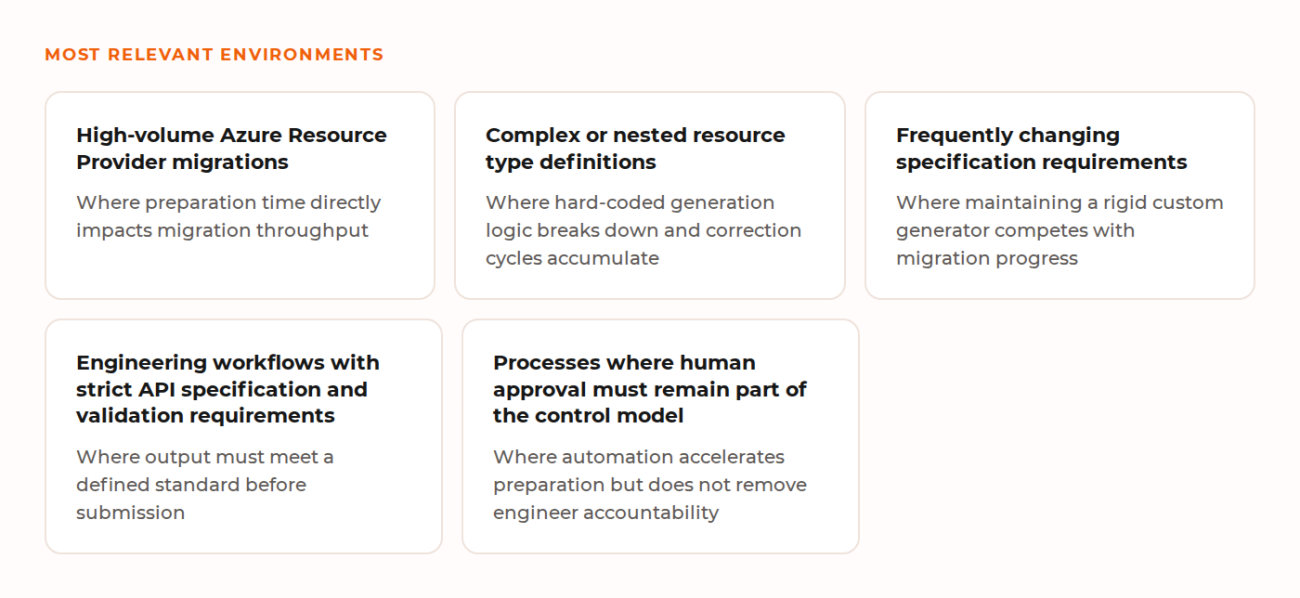
The implementation covered repositories and workflows related to Azure Resource Provider TypeSpec generation and validation. Human review remains required, and testing and validation are not fully autonomous.
The underlying pattern may also be relevant to other specification-heavy engineering workflows where requirements evolve, definitions are structurally complex, and final human approval is non-negotiable. Any extension beyond the current Azure Resource Provider scope would require workflow-specific validation and adaptation.
Conclusion
Akvelon created an AI-assisted engineering capability that combined code-based generation, automated validation, error correction, and mandatory human review in one controlled workflow.
By moving from rigid rules-based automation to a Copilot-based skill, the team reduced average time-to-PR from 24–40 hours to 15–30 minutes while preserving engineer accountability. The result is a practical example of how AI can modernize an existing engineering process – not by removing human judgment, but by concentrating it where it adds the most value.