

For a large enterprise client with hundreds of legacy .NET projects, AI-assisted migration was already in place. But migration was only part of the process: build validation and review preparation still required additional engineering effort.
Akvelon extended the existing migration capability with dedicated build-output validation and migration-review skills, then combined all three into a toolkit for easier distribution and versioning across teams.
Our Client: A Global Technology Company
Our client is a global technology company with a large portfolio of enterprise software and cloud services, operating across a complex, distributed engineering environment. Its software ecosystem includes hundreds of long-lived .NET projects, built up over time and maintained across many teams – one internal repository alone contains close to 700 projects that may still require migration.
When they engaged Akvelon, the goal was to modernize this legacy footprint at scale while minimizing the manual effort required to validate migrations and prepare them for review.
The Challenge: Validation and Review Became a Bottleneck
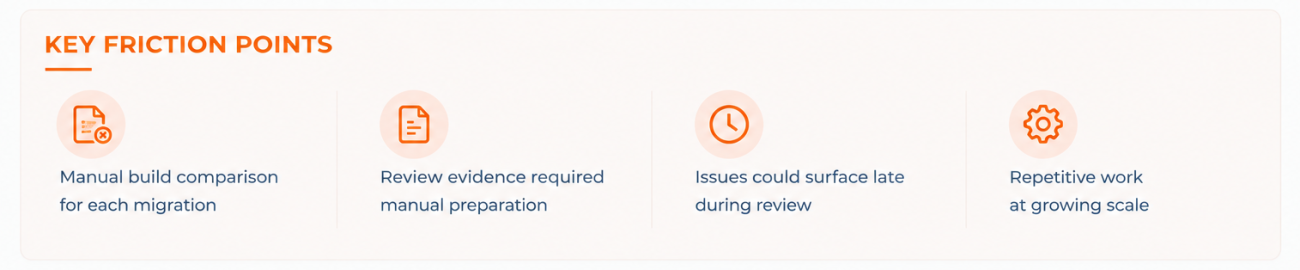
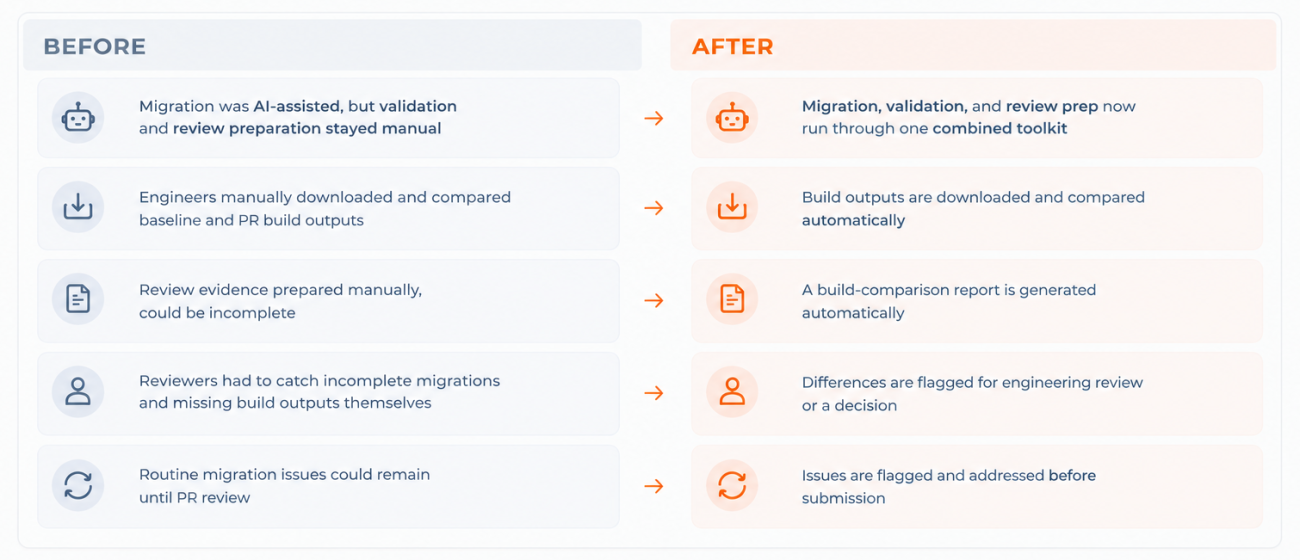
Once migration itself was AI-assisted, the remaining work shifted downstream. Engineers still had to download baseline and pull-request build outputs, compare them, and prepare evidence showing that the migration was complete and compatible.
That process created two problems. First, validation was repetitive: the same comparison work had to be performed for each migration. Second, incomplete migrations or missing build outputs could surface during review, creating additional back-and-forth and rework.
At the scale of a backlog containing hundreds of legacy projects, this made validation and review preparation an operational bottleneck.
Technical Approach: Combining Migration, Validation, and Review Into One Toolkit
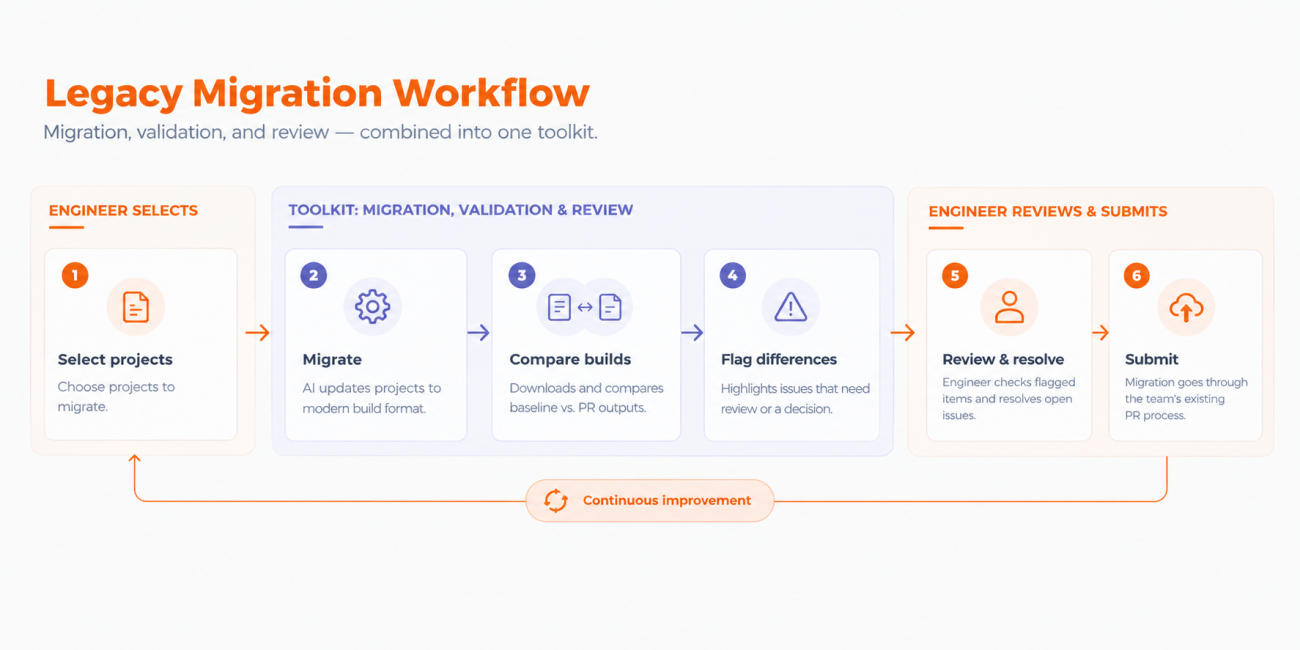
Akvelon added two new AI skills – build-output validation and migration review – to the existing migration capability, then combined all three into a toolkit for easier distribution and versioning across teams.
The toolkit automates the preparation and validation steps around migration: it compares build outputs against the baseline and flags anything that needs an engineering decision, such as an incomplete migration, missing output, or unexpected difference.
Engineers review and resolve flagged items, then submit through the existing PR process. The migration, build-output comparison, and issue flagging steps are automated – project-specific decisions remain with the engineer.
Results & Operational Impact
Since the validation skill's rollout, it has been used in 71% of relevant migration pull requests (54 of 76). Across the full measured dataset, including the period before rollout, the rate was 47% (80 of 169 relevant migration PRs).
The team estimates roughly 46–54 engineering hours saved per month at current adoption levels. The estimate combines assumed time savings from build-comparison preparation with estimated review-efficiency gains from avoided review iterations. This is a planning estimate, not a measured result.
The scale of the backlog also makes repeatability important. The repository in this engagement contains approximately 696 candidate projects that may still require migration to SDK-style format, subject to project-level validation.
At that scale, the ability to roll the workflow out efficiently matters: setup is estimated at 1–2 hours per team to install the toolkit, walk through when to use it, and run one guided example.
Where This Approach Delivers Value
This pattern is most useful when teams face a large backlog of similar legacy migrations and the repetitive work around validation and review starts competing with engineering time.
It can be applied to scenarios such as:
- Large .NET modernization backlogs – many similar projects moving to a modern build format.
- Multi-team migrations – consistent validation and review preparation across teams.
- Repeated migration waves – the same comparison and review steps repeated at scale.
- Existing PR workflows – AI automates preparation and validation while engineers make the decisions.
The key opportunity is extending AI beyond migration itself to automate repetitive validation and review work, freeing engineers to focus on project-specific decisions.
The same approach can also be applied to similar migration patterns in other repositories.